
Members financial returns
A detailed analysis on how well has Mobius served its members financially over the past 29 years?
Summary
Over nearly three decades, the Mobius Investment Club has brought together individuals interested in learning about investing through practice, discussion, and shared decision-making. Founded in 1997 and inspired by the investment club movement promoted by ProShare UK, Mobius has combined modest monthly subscriptions with collective research and long-term participation in equity markets. As the club approaches its third decade, it becomes possible to step back and ask a natural question: how well has the club served its members financially?
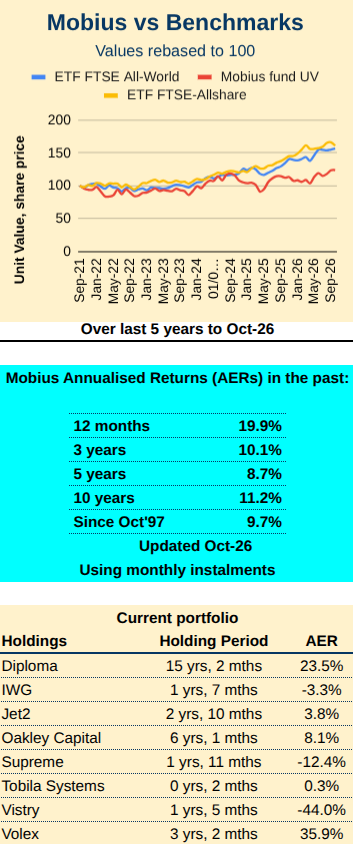
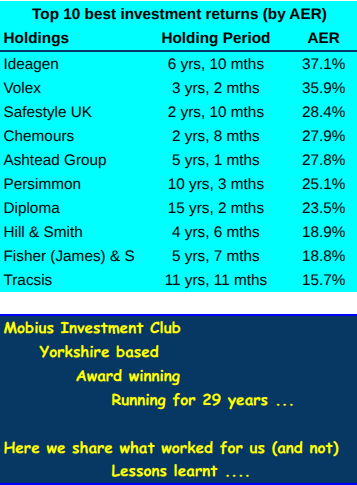
An analysis of the investment returns of the forty members who have participated in the club shows broadly positive results. The average member achieved an annual equivalent rate (AER) of around 7.2%, with most gains clustered between 5% and 10% per year. The Mobius portfolio itself has delivered a long-term AER of approximately 9.3% since 1997, placing it broadly in line with (and at times slightly ahead of) the long-term returns historically associated with the UK equity market represented by the FTSE All-Share Index. While investment clubs exist primarily to learn and enjoy investing together, the evidence suggests that Mobius members have also achieved respectable financial outcomes along the way. The analysis also introduces a shift in perspective, moving beyond traditional fund-level analysis to consider how individual members have experienced returns over time.
Introduction
Since its formation in October 1997, the Mobius Investment Club has brought together individuals with a shared interest in learning about investing and participating directly in financial markets. Like many clubs affiliated with ProShare UK, Mobius was founded on a simple idea: that investing can be learned best through collective discussion, disciplined contributions, and long-term participation.
Nearly three decades later, a natural question arises: how well has the club served its members financially?
Investment clubs were never intended to be purely performance vehicles. They were conceived primarily as learning platforms. Yet over time, with regular monthly subscriptions and the accumulation of capital, the investment element becomes increasingly meaningful. Returns therefore matter not only as a financial outcome, but also as a measure of whether the club’s collective process has worked.
This article looks at the experience of Mobius members through one key metric: Annual Equivalent Rate (AER). This analysis also reflects a subtle shift in perspective, from viewing Mobius purely as a fund to understanding how its members themselves have experienced the journey.
From Learning to Investment Returns
It is important to remember that investment clubs were designed with a broader purpose than simply maximising returns. The traditional ProShare model emphasised three objectives:
- To learn: Understanding companies, markets, and investment principles.
- To enjoy:The social dimension of a club built around shared discussion.
- To invest:Applying ideas in a real portfolio.
Monthly contributions were deliberately called “subscriptions”, echoing the idea that members were paying a modest fee to learn (much like joining a course or educational programme).
Over time, however, the accumulation of capital inevitably introduces a fourth dimension: financial returns. When subscriptions compound over many years, the club’s net asset value becomes meaningful, and performance naturally attracts greater interest.
Measuring Returns: Why AER Matters
Members of investment clubs contribute gradually over time through regular monthly subscriptions. Because investments are made periodically rather than as a single lump sum, simple cumulative returns do not tell the full story.
For this reason, Mobius uses AER, calculated through an XIRR methodology, as the primary measure of performance. AER captures the effective annual rate earned on a stream of contributions made at different points in time. In other words, it reflects the reality of how members actually invested.
This allows us to compare outcomes across members who may have joined at different times and stayed in the club for different durations.
The Membership Perspective
Over its lifetime (todate, March 2026), Mobius has had 40 members, including nine current members and thirty-one former members. Each member’s individual investment history allows us to calculate a personal AER based on their subscription pattern and the value realised when leaving the club (or the current valuation for active members).
Across all members, the average AER stands at approximately 7.2%, with an interquartile mean of about 6%. The median return is also close to 6%, indicating that the overall result is not driven by a small number of exceptional outcomes but reflects a broadly consistent experience across the membership.
These figures suggest that the typical Mobius member achieved a mid-single-digit annual return over their participation period, despite joining in very different market conditions over nearly three decades.
Distribution of Member Returns
The frequency distribution of members’ AERs provides a useful first perspective on the club’s returns.
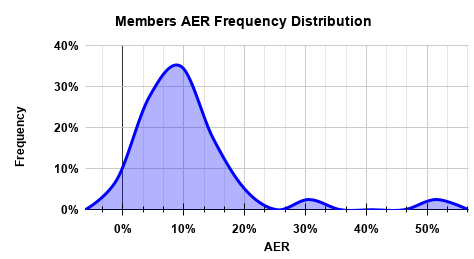
The chart shows a broadly bell-shaped distribution centred between roughly 5% and 10%, which is a healthy pattern for long-term investment outcomes. Most members fall within this range, indicating that the club’s investment process has produced relatively consistent results across different generations of members.
Only six members experienced a negative AER. Three of these were only slightly below zero (between -0.6% and -1.6%), while the others reflect more challenging investment periods.
Put differently, the large majority of members achieved positive annualised returns during their time in the club. For a club whose primary mission is educational rather than purely financial, this represents a pretty good result.
At the upper end of the distribution there are naturally a few higher values. One particularly high AER reflects a member with a relatively short participation period (15 months) during a favourable market phase. While interesting, such cases should be interpreted cautiously, as short durations can amplify annualised return calculations. The broader distribution gives a more representative picture of the club’s long-term experience.
A Second Perspective: Time in the Club
Returns can also be examined from another angle: the relationship between AER and the length of time members spent in the club. This scatter chart plots each member’s AER against their membership duration, while distinguishing between current members and former members. Several observations emerge.
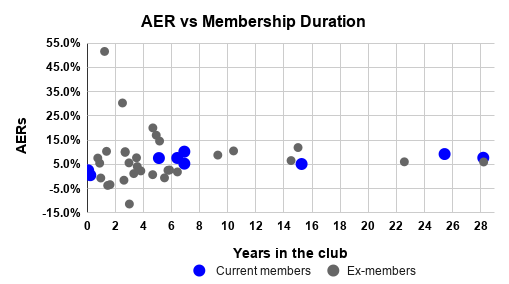
At first glance, the chart suggests there is no obvious relationship between duration and annualised return. This impression is confirmed statistically: the correlation coefficient between membership duration and AER is approximately 0.01, indicating that no meaningful linear relationship exists between the two variables. In simple terms, staying longer in the club did not automatically result in higher (or lower) annualised returns.
However, this does not mean that time plays no role: A separate Mobius study, “Timing the Market” (Dec. 2025), highlights a different and important dimension: while duration may not drive higher AERs, it increases the probability of achieving a positive outcome. This can already be observed in the scatter plot beyond approximately 3 years and 4 months, all members recorded a positive AER. Extending this further, the study shows that for any holding period longer than 7 years and 2 months, no members would have experienced a loss.
To place this in context, the average membership duration across all members is approximately 7 years, with an interquartile mean of about 4 years and 8 months. The median duration is also close to this level, suggesting that while some members stayed significantly longer, a central tendency emerges around five years as a typical period of participation.
Taken together, these observations reflect a familiar principle of investing: while time does not guarantee higher returns, it meaningfully reduces the likelihood of loss. In that sense, the Mobius experience mirrors a broader investing truth; not necessarily timing the market, but time in the market.
The chart also highlights the diversity of individual experiences within the club. Members joined at different moments in the market cycle, some during periods of strong equity growth, others during more turbulent phases. Yet the overall spread remains centred around the mid-single-digit range. This diversity is typical of real-world investing and reflects the fact that the club has lived through multiple market cycles since the late 1990s.
A Shift in Perspective: From Fund to Members
For much of its history, Mobius has analysed its performance primarily through the lens of the club as an investment fund.
Like many private investor groups, the club naturally adopted frameworks similar to those used by professional fund managers focusing on measures such as unit value, portfolio growth, capital versus income splits, and performance over standard periods (1, 3, 5, 10 years and since inception). In many respects, Mobius reporting evolved to mirror that of a small collective fund, not unlike an OEIC or unit trust. These perspectives are valuable and remain an important way of understanding how the club has performed as a whole.
However, the analysis presented in this article reflects a different and, in hindsight, surprisingly overlooked viewpoint: that of the individual member. By focusing on each member’s own sequence of contributions and outcomes, and by measuring returns through AER, the emphasis shifts from the portfolio to the people behind it. It becomes possible to ask not just how the fund performed, but how members themselves experienced that performance.
That this perspective had not been explored in detail before is perhaps a reflection of how naturally investment thinking gravitates towards fund-level analysis. Yet for an investment club where individuals join, contribute, learn, and eventually leave, the member perspective is arguably the most meaningful of all.
In bringing these two views together, the fund perspective and the member perspective, we gain a more complete understanding of what Mobius has achieved over time
A Small Club in a Long Tradition
Investment clubs occupy a distinctive place in the investing landscape. They are neither professional asset managers nor purely theoretical classrooms. Instead, they sit somewhere in between communities where individuals learn about markets by participating in them. By pooling modest contributions and sharing research, members gain both experience and perspective that might be difficult to achieve alone.
Mobius is one small example of this tradition. Over the years, forty individuals have participated in the club, each bringing their own insights, questions, and curiosity about investing.
The data suggests that the experiment has been worthwhile. Members have not only shared the experience of learning together but have also, in most cases, seen their subscriptions grow over time.
For a club whose original aim was simply to learn, to enjoy, and to invest, that is perhaps the most satisfying outcome of all.
Appendix: Understanding AER and XIRR
Why AER Is Used
Members of investment clubs typically invest through regular monthly subscriptions rather than a single lump sum. Because money is invested gradually over time, measuring returns requires a method that accounts for both the size and timing of each contribution (cash-flow series).
This is why Mobius uses the Annual Equivalent Rate (AER) calculated through a method known as XIRR (a function widely available in spreadsheets such as MS Excel or Google Sheets).
What XIRR Does
XIRR calculates the annualised return that equates:
- the series of monthly contributions made by a member, and
- the value received when leaving the club (or the current valuation).
In other words, it answers the question: What annual return would produce the same final value if all the cash flows were taken into account?
Why This Matters
Two members may have invested the same total amount but at different times or for different durations. A simple gain or loss percentage would not capture that difference properly.
Using AER/XIRR ensures that returns are comparable across members, even though they joined the club in different years and stayed for different periods. This makes AER a particularly suitable measure for evaluating the outcomes of long-running investment clubs.


